A plain ceiling can make a beautiful room feel unfinished, even when the furniture, paint, and lighting all look right. Ceiling medallion installation gives an ordinary fixture a framed, intentional look without tearing into drywall or rebuilding the room around it. For many U.S. homeowners, that matters because older houses, builder-grade condos, and newer suburban homes often share the same problem: decent rooms with flat ceilings that give the eye nowhere to land. A medallion adds shape, shadow, and character around a chandelier, pendant, flush mount, or ceiling fan. It can make a dining room feel settled, a bedroom feel softer, or a hallway feel less like leftover space. If you study trusted home improvement publishing resources, one pattern becomes clear: small architectural details often carry more weight than loud design moves. The trick is choosing a medallion that looks like it belongs there, not one that screams for attention.
Start With the Room Before You Start With the Fixture
Good design starts with the whole room, not the object you are excited to buy. A ceiling medallion should support the ceiling height, trim style, fixture shape, and wall color already in play. When it ignores those pieces, it can look like a costume part pasted onto the ceiling.
Decorative ceiling medallions work best when they solve a visual gap. A narrow dining room may need a medallion to make a pendant feel anchored. A tall foyer may need one to soften the long drop between ceiling and floor. A small bedroom may need less ornament than the product photo suggests.
Match the Medallion Mood to the House Style
A 1920s bungalow in Ohio can handle more carved detail than a clean-lined ranch in Arizona. The mistake is treating every medallion as a vintage feature. Some rooms need leaves, beads, and floral relief. Others need a simple ring with a shallow edge.
American homes carry different design histories by region. A New England colonial dining room may welcome a classic oval or round medallion with quiet trim detail. A newer Texas open-plan living room may look better with a broad, smooth profile that adds scale without adding fuss.
The best test is to compare the medallion to your existing trim. If the crown molding, door casing, or baseboards are plain, a heavy ceiling piece may feel out of sync. If your trim already has depth and pattern, the ceiling can take a little more personality.
Let Ceiling Height Control the Drama
Low ceilings punish oversized details fast. A thick, ornate medallion around a flush mount can make an 8-foot ceiling feel lower, even when the piece itself is not large. The eye reads shadow as depth, and too much depth overhead can feel heavy.
Higher ceilings give you more room to play. A two-story entry with a chandelier often needs a larger medallion because the fixture is seen from below and across the space. A small medallion there can disappear, leaving the chandelier looking lonely.
Ceiling medallion size should never be chosen from a product image alone. Measure the fixture width, room width, and ceiling height first. A 24-inch medallion can feel generous in a bedroom, but weak in a wide foyer with a large chandelier.
Choose Shape and Scale With More Care Than Color
Color can change later, but scale is far less forgiving. A medallion that is too small looks timid. One that is too large looks theatrical in the wrong way. Shape matters because it decides how the light fixture sits inside the ceiling plane.
This is where a light fixture upgrade can either feel polished or oddly forced. The medallion should make the fixture look settled, not swallowed. A pendant, chandelier, fan, or flush mount each needs a different visual relationship with the ceiling.
Round, Oval, Square, or Starburst Shapes
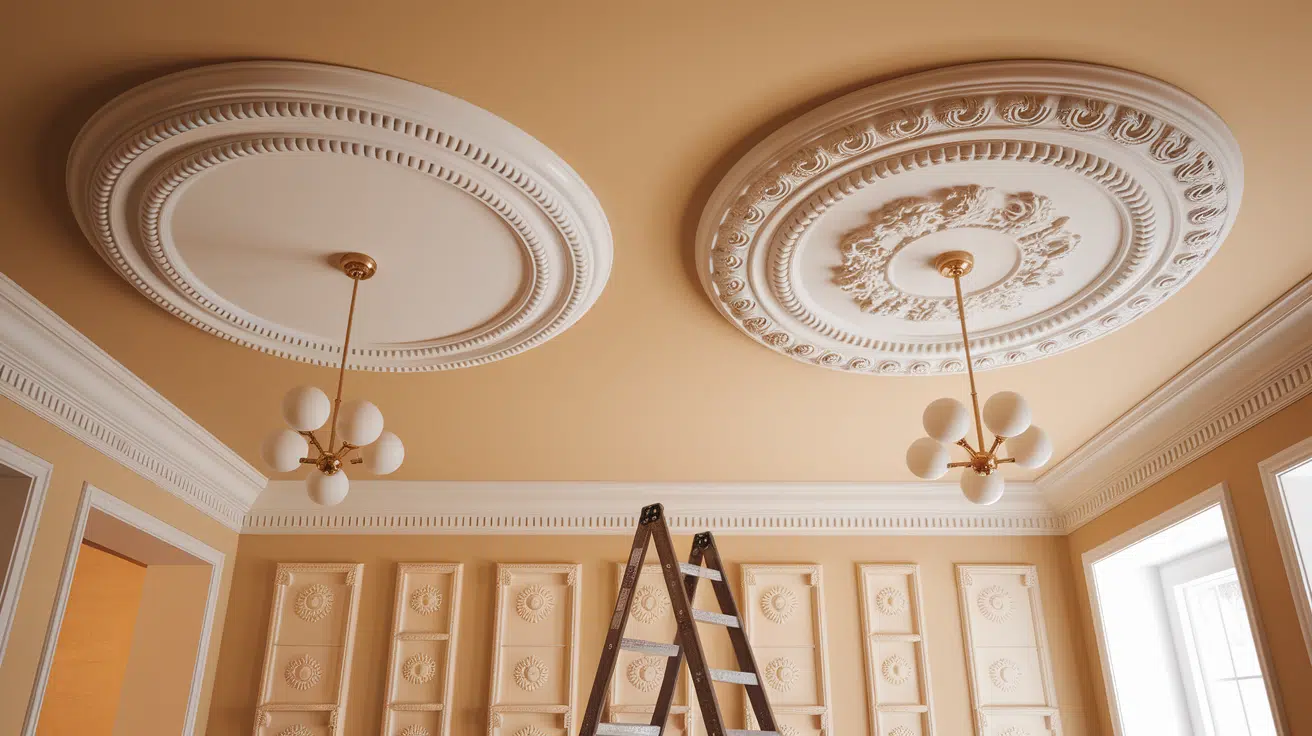
Round medallions are the safest choice because most light canopies are round. They work in bedrooms, dining rooms, foyers, hallways, and living rooms. A round piece also softens rooms with sharp furniture lines, which is why it often works above rectangular dining tables.
Oval medallions can look graceful above long dining tables or in narrow rooms. They stretch the ceiling visually, which helps when the fixture hangs in a room that already feels tight. The catch is alignment. If the oval sits even slightly off from the table or fixture, the mistake becomes visible.
Square and starburst medallions ask for more confidence. A square piece can suit a craftsman home, modern farmhouse kitchen, or square foyer. A starburst style can wake up a plain midcentury room, but it needs restraint nearby. Too many bold shapes in one ceiling zone turn charm into noise.
Why Fixture Canopy Size Matters
The canopy is the small plate that covers the wiring box at the ceiling. Many homeowners ignore it, then discover the medallion center opening is too wide, too narrow, or awkwardly shaped. That small detail can make the finished job look patched together.
A wide chandelier canopy may cover the medallion opening with no issue. A slim pendant canopy may expose gaps unless you choose a medallion with a smaller center hole or use a clean trim ring. This is one of those boring checks that saves the whole project.
Ceiling medallion size also needs to account for the canopy edge. The fixture should sit neatly over the center opening, and the medallion should extend enough beyond the canopy to look intentional. Too little border makes the medallion feel like a washer behind the light.
Install With Patience, Not Panic
The ceiling is unforgiving because every crooked line sits overhead in plain view. That does not mean the job has to be scary. It means the planning should be calmer than the buying. The best-looking results usually come from slow measuring, clean dry-fitting, and resisting the urge to rush the adhesive step.
A painted ceiling medallion may look finished before it ever touches the ceiling, but installation decides whether it feels built-in. Even lightweight polyurethane pieces need careful placement. Plaster versions need even more respect because weight changes everything.
Pre-Paint Before the Medallion Goes Up
Painting on the ceiling sounds easy until your arms are tired and wet paint starts collecting along raised edges. Pre-painting on a workbench gives you cleaner coverage and better control over the details. It also helps you catch mold lines, rough edges, or dents before the piece is overhead.
White is not the only smart choice. A medallion painted the same color as the ceiling gives a subtle architectural effect. A soft contrast can frame a chandelier in a dining room. A darker tone can work in a moody powder room, but it needs a confident fixture.
A painted ceiling medallion should be dry before installation begins. That sounds obvious, but tacky paint can grab dust, smear against the ceiling, or peel when you adjust the piece. Let the finish cure long enough that handling it does not leave fingerprints.
Respect Wiring, Weight, and the Ceiling Box
The medallion is decorative, not structural. It should never carry the weight of the fixture or fan. The electrical box and mounting hardware must support the light, while the medallion sits around that connection as trim. That distinction matters.
Turn off power at the breaker before removing a fixture. If the wiring looks old, damaged, crowded, or confusing, bring in a licensed electrician. Many older U.S. homes have ceiling boxes that were never meant for heavy fixtures, and guessing overhead is a poor place to save money.
Lightweight medallions often attach with construction adhesive and finish nails or screws, depending on the ceiling surface and product directions. Caulk fills the tiny edge gap after mounting. That final bead matters because it turns a stuck-on object into something that looks part of the room.
Make the Finished Detail Feel Intentional
A medallion should not be the only detail speaking in the room. Once it is up, the nearby elements need to agree with it. That may mean changing the bulb shape, shortening a chain, painting the canopy, or adding trim elsewhere so the ceiling detail does not feel alone.
Decorative ceiling medallions can look expensive when they are part of a wider design language. They can also look awkward when the rest of the room stays builder-basic. The goal is not to make every surface ornate. The goal is to make the room feel edited.
Use Finish Choices to Connect the Whole Room
A brass chandelier under a white medallion can look crisp in a dining room with warm wood furniture. A matte black pendant under a simple ring can work in a kitchen with black cabinet pulls. These small finish echoes help the ceiling detail feel connected.
The canopy finish deserves attention too. If the canopy looks cheap, scratched, or mismatched, the medallion will frame the flaw. Sometimes the smartest light fixture upgrade is not a new fixture at all. It is repainting or replacing the canopy so the ceiling line looks clean.
Paint also creates connection. Matching the medallion to the crown molding can give a traditional room a calmer look. Matching it to the ceiling hides bulk. Using a slight contrast draws the eye upward, which can help in rooms where the fixture deserves attention.
Know When Simple Beats Ornate
A plain ring can beat a carved floral medallion in more rooms than people expect. Ornament works when the house has room for it. It fails when the room already has patterned rugs, busy curtains, open shelving, wall art, and a statement fixture competing for the same attention.
Small rooms need discipline. A powder room can handle drama because it is enclosed and brief. A small bedroom may need quiet lines because you live with that ceiling every night. The same detail that feels charming in one space can feel restless in another.
A medallion should make the fixture look chosen. That is the real win. When guests notice the room feels finished before they notice the medallion itself, the detail has done its job.
Conclusion
The smartest ceiling details do not beg for attention. They give the room a sense of order, then step back and let the fixture, furniture, and light do their work. That is why ceiling medallion installation can be such a strong upgrade for plain American homes: it fixes a visual weakness without demanding a full renovation. Start with scale, respect the fixture canopy, keep the house style in mind, and do not buy the most ornate option unless the room has earned it. A clean medallion, fitted well and finished with care, can make a budget pendant feel custom and a standard dining room feel considered. Before you paint another wall or replace another light, look up. The ceiling may already be telling you where the room needs its next smart move.
Frequently Asked Questions
What size ceiling medallion works best for a dining room light?
Measure the chandelier width and room size before buying. Many dining rooms look balanced when the medallion is wider than the fixture canopy but not wider than the chandelier itself. Larger rooms and taller ceilings can handle broader designs with more detail.
Can you install a ceiling medallion without removing the light fixture?
Split medallions can be installed around some existing fixtures, but full medallions usually require fixture removal. Turning off power at the breaker is still necessary. If the wiring or mounting looks questionable, hire an electrician before moving forward.
Are decorative ceiling medallions good for modern homes?
Modern homes can use them well when the design stays simple. Choose smooth rings, shallow profiles, or geometric shapes instead of heavy floral patterns. The goal is architectural polish, not old-fashioned ornament forced into a room that does not want it.
Should a ceiling medallion match the ceiling or the light fixture?
Matching the ceiling creates a built-in look, while matching fixture finishes adds contrast. Most homeowners get the safest result by painting the medallion the ceiling color, then letting the light fixture provide the metal, glass, or fabric detail.
Can a ceiling medallion be used with a ceiling fan?
A medallion can work with a ceiling fan if the fan mount, canopy, and electrical box are compatible. The medallion must not support the fan’s weight. Fan-rated boxes and secure mounting matter more than the decorative piece around them.
What material is best for a lightweight ceiling medallion?
Polyurethane is popular because it is light, easy to paint, and easier to handle than plaster. Plaster has an authentic feel but weighs more and may need extra care. For most DIY-friendly U.S. homes, lightweight materials are easier to manage.
How do you paint a ceiling medallion before installing it?
Prime it if the product requires primer, then use thin coats to avoid filling raised details. Paint on a flat surface and let each coat dry fully. A small angled brush helps reach curves, beads, and carved areas without leaving heavy buildup.
Do ceiling medallions add value to a home?
They can improve perceived value by making a room look finished and custom. They rarely change appraisal numbers alone, but they can strengthen buyer impressions in dining rooms, foyers, bedrooms, and living spaces where lighting already draws attention.